Use case
Fake, prank and duplicate COD orders: how to catch them before the parcel leaves.
ভুয়া, প্র্যাংক আর ভুল করে দুইবার দেওয়া COD অর্ডার: পার্সেল ছাড়ার আগেই কীভাবে ধরবেন।
Updated
Not every unwanted parcel starts with a deliberate fake order. Someone places an order as a prank, a competitor sends orders to waste a shop’s time, or a real customer taps the order button twice by mistake. Another customer simply changes their mind after buying. Each needs a different conversation before you ship.
The shop pays for the courier’s trip out and the return journey. While the parcel travels, its stock sits in transit instead of being available for another buyer. A return also means checking the goods and putting them back on the shelf. Work out that cost for your own shop with the calculator in Further reading.
In the order list, these look like ordinary purchases: a name, a phone number, some items and an address. A familiar number can belong to a duplicate order; a new number can belong to a real buyer. Neither a neat address nor a poor delivery history settles whether this particular parcel is wanted.
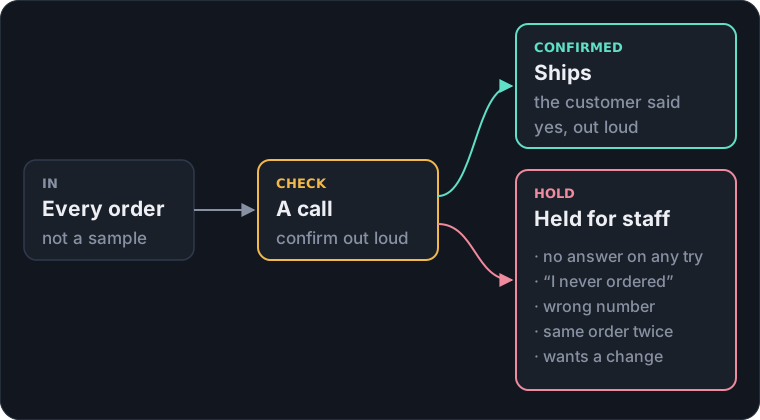
How it works
- 01
Check the number’s courier history
Before a parcel leaves, run three checks. Start with the number’s courier history, for example in our free courier fraud checker. It shows past deliveries and returns that couriers reported for that number. It cannot tell you whether the customer placed this order or still wants it; a new number may have no history at all.
- 02
Hear a yes and read the address back
Call the customer before packing, or let the agent call from a local Bangladeshi number. It names your shop, reads the items and total, and asks the customer to confirm out loud. It then reads the address back and records the thana and district, including corrections.
- 03
Have a person decide on every hold
No answer, a refusal, a wrong number or a requested change leaves the order on hold with a note. Staff review the reason and any call recording before they act. Nothing is cancelled by itself, including an order from a real customer who was busy when the phone rang.
What your staff see
- Confirmed by the customer's own voice, ready to ship
- Hold: no answer on any attempt
- Hold: the customer says they never ordered
- Hold: wrong number, or an abusive caller flagged so you can stop calling it
Four kinds of order that come back
| Kind | In your order list | On the call |
|---|---|---|
| Prank | A made-up name and a real-looking number | Nobody answers, or “I never ordered” |
| Duplicate | The same order twice, minutes apart | The customer hears it twice and keeps one |
| Cold feet | A real order from a real customer | They cancel before the parcel leaves |
| Competitor | A burst of orders in a short time | Numbers that never answer |
Five signs of a fake order
A number that never answers: attempts go unanswered and nobody confirms the items or total. Keep the order on hold; a busy customer and a fake order can look the same from the call log.
An address with no thana or district: the field may contain only a market, a mosque or another landmark. Ask for the missing details before the packing desk treats it as a delivery address.
Several orders from one number within minutes: the same basket appears again while the first order is still waiting. Ask which order the customer wants to keep before preparing separate parcels.
An order far above the shop’s usual basket: a much larger quantity or total deserves a careful read-back. An unusual purchase is a reason to check, not proof of fraud.
A burst of orders at odd hours: several similar orders arrive together when the shop normally sees little activity. Check the numbers and speak to the customers before treating the burst as confirmed sales.
What a fraud check tells you, and what only a call can
The checker shows the number’s courier history: deliveries and returns reported in the past. That helps staff decide what to look at more carefully. It cannot say whether this order was a prank, an accidental repeat or a purchase the customer now wants to cancel.
The call asks about today’s order. The customer hears the items and amount and can say yes, explain a duplicate or correct the delivery address. Use that answer alongside the history. If nobody answers, leave the order for a person to review rather than labelling the customer a fraud.
A checklist for the packing desk
Check the phone number’s courier history and look for repeat orders in your own list.
Call the customer, or let the agent call, and ask them to confirm the items and total in their own words.
Read the address back and record the thana and district the customer gives.
Hold anything unclear, with a note explaining what a member of staff needs to resolve.
Never ship on silence: no answer is not a yes.
Further reading
- AI calling for e-commerce in Bangladesh: confirmation, address and delivery calls for online shops in one place.
- How the order confirmation call works: the transcript, the retries, the note your staff get and the cost per call.
- Fake COD orders: how to catch them before shipping: the four kinds of order that come back, and how each is caught.
- Free courier fraud checker: see a number's past deliveries and returns before you ship. 2 free checks a day.
- ফ্রড চেকার কি যথেষ্ট?: what a fraud check catches, and what only a call can.
- অগ্রিম ডেলিভারি চার্জ, নাকি কনফার্মেশন কল?: when to ask for the delivery fee up front.
- অর্ডার কনফার্ম মেসেজ টেমপ্লেট: Bangla SMS and WhatsApp messages to send before the call.
- Parcel return cost calculator: what fake and returned orders cost you, with your own numbers.
- Order confirmation call services in Bangladesh, compared: five services side by side.
What clients say
“If you’ve been thinking about trying this, take it as a sign. I’m really glad I did.”
Emam Hossen Rana
Owner and CEO, BD Trendz
- Order confirmation
- Customer support
- Database updates
Try it on your own orders
৳4 per minute, billed by the second, only for answered calls. Sign up and start with 2 free minutes, no credit card; our team sets up the assistant for your shop.
Related questions
- What happens if the customer does not pick up?
The agent tries again later. Each account has its own number of attempts, up to 10. If nobody answers any of them, the order goes on hold with the reason "no answer", and a person decides what to do. You are not charged for calls nobody answers.
- Can the call catch a duplicate order?
Each order gets its own call, and the agent reads out the items and the total. A customer who placed the same order twice hears it read out twice and can cancel the extra one. That order goes on hold with a note such as "the customer placed the same order twice by mistake", and your staff take it out before it ships.
- Is a courier fraud check enough to stop fake orders?
A fraud check shows a phone number's past deliveries and returns with the couriers. It is a good first look, but it cannot tell you whether this order is real: a new number has no history, and a clean record does not prove that today's order was placed on purpose.
- Are calls recorded, and for how long are they kept?
Every call is recorded, so you can check it if an order is disputed. Recordings are kept for 90 days and then deleted. The one-line note and the result stay with the order. Because your business is the one making the call, it is up to you to tell customers that calls are recorded.
For shops: COD order confirmation calls · Delivery address verification
For any business: AI voice agent · AI call center · AI outbound calling agent · AI receptionist · AI inbound customer support · Custom AI · Bangla text to speech